Showing posts with label physiology. Show all posts
Showing posts with label physiology. Show all posts
Tuesday, January 1, 2013
Evidence Supports Health Benefits of 'Mindfulness-Based Practices'
Specific types of "mindfulness practices" including Zen meditation have demonstrated benefits for patients with certain physical and mental health problems, according to a report in the July Journal of Psychiatric Practice.
"An extensive review of therapies that include meditation as a key component -- referred to as mindfulness-based practices -- shows convincing evidence that such interventions are effective in the treatment of psychiatric symptoms and pain, when used in combination with more conventional therapies," according to Dr William R. Marchand of the George E. Wahlen Veterans Affairs Medical Center and the University of Utah in Salt Lake City.
Mindfulness Techniques Show Health Benefits
Dr Marchand reviewed published studies evaluating the health benefits of mindfulness-based practices. Mindfulness has been described as "the practice of learning to focus attention on moment-by-moment experience with an attitude of curiosity, openness, and acceptance." Put another way, "Practicing mindfulness is simply experiencing the present moment, without trying to change anything."
The review focused on three techniques:


Mindfulness Meditation Training Changes Brain Structure in Eight Weeks
Participating in an 8-week mindfulness meditation program appears to make measurable changes in brain regions associated with memory, sense of self, empathy and stress. In a study that will appear in the January 30 issue of Psychiatry Research: Neuroimaging, a team led by Massachusetts General Hospital (MGH) researchers report the results of their study, the first to document meditation-produced changes over time in the brain's grey matter.
"Although the practice of meditation is associated with a sense of peacefulness and physical relaxation, practitioners have long claimed that meditation also provides cognitive and psychological benefits that persist throughout the day," says Sara Lazar, PhD, of the MGH Psychiatric Neuroimaging Research Program, the study's senior author. "This study demonstrates that changes in brain structure may underlie some of these reported improvements and that people are not just feeling better because they are spending time relaxing."

Previous studies from Lazar's group and others found structural differences between the brains of experienced mediation practitioners and individuals with no history of meditation, observing thickening of the cerebral cortex in areas associated with attention and emotional integration. But those investigations could not document that those differences were actually produced by meditation.
Friday, December 9, 2011
Brains of Buddhist monks scanned in meditation study

In a laboratory tucked away off a noisy New York City street, a soft-spoken neuroscientist has been placing Tibetan Buddhist monks into a car-sized brain scanner to better understand the ancient practice of meditation.
But could this unusual research not only unravel the secrets of leading a harmonious life but also shed light on some of the world's more mysterious diseases?
Zoran Josipovic, a research scientist and adjunct professor at New York University, says he has been peering into the brains of monks while they meditate in an attempt to understand how their brains reorganise themselves during the exercise.
Since 2008, the researcher has been placing the minds and bodies of prominent Buddhist figures into a five-tonne (5,000kg) functional magnetic resonance imaging (fMRI) machine.
The scanner tracks blood flow within the monks' heads as they meditate inside its clunky walls, which echoes a musical rhythm when the machine is operating.
Dr Josipovic, who also moonlights as a Buddhist monk, says he is hoping to find how some meditators achieve a state of "nonduality" or "oneness" with the world, a unifying consciousness between a person and their environment.
 The study specifically looks at the default network in the brain, which controls self-reflective thoughts
"One thing that meditation does for those who practise it a lot is that it cultivates attentional skills," Dr Josipovic says, adding that those harnessed skills can help lead to a more tranquil and happier way of being.
Meditation Can 'Turn Off' Regions of the Brain
Brain imaging shows experienced meditators can prevent their minds from wandering
By Robert Preidt
Tuesday, November 22, 2011  (HealthDay News) -- A new study finds that people skilled at meditation seem able to turn off areas of the brain associated with daydreaming and psychiatric disorders such as autism and schizophrenia.
Learning more about how meditation works could help advance research into a number of diseases, according to lead author Dr. Judson Brewer, an assistant professor of psychiatry at Yale University.
He and his colleagues used functional MRI to assess brain activity in experienced and novice meditators as they performed three different meditation techniques.
Regardless of the type of meditation, skilled meditators had decreased activity in the brain's default mode network, which has been linked to attention lapses and disorders such as anxiety, attention deficit hyperactivity disorder, and the buildup of beta amyloid plaques associated with Alzheimer's disease.
The researchers also found that when the default mode network (which consists of the medial prefrontal and posterior cingulate cortex) was active, brain regions associated with self-monitoring and cognitive control were also activated in experienced meditators, but not novices.
This suggests that skilled meditators constantly monitor and suppress the emergence of "me" thoughts and mind wandering. If they become too strong, these two states of mind are associated with diseases such as autism and schizophrenia.
Saturday, December 3, 2011
Can meditation change your brain? Contemplative neuroscientists believe it can
From CNN's Dan Gilgoff:
Can people strengthen the brain circuits associated with happiness and positive behavior, just as we’re able to strengthen muscles with exercise?
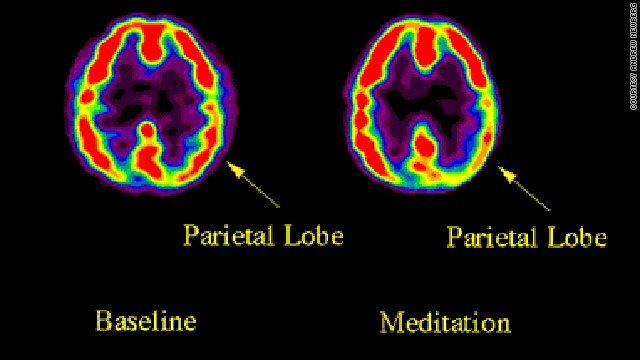 Richard Davidson, who for decades has practiced Buddhist-style meditation – a form of mental exercise, he says – insists that we can.
And Davidson, who has been meditating since visiting India as a Harvard grad student in the 1970s, has credibility on the subject beyond his own experience.
A trained psychologist based at the University of Wisconsin, Madison, he has become the leader of a relatively new field called contemplative neuroscience - the brain science of meditation.
Over the last decade, Davidson and his colleagues have produced scientific evidence for the theory that meditation - the ancient eastern practice of sitting, usually accompanied by focusing on certain objects - permanently changes the brain for the better.
“We all know that if you engage in certain kinds of exercise on a regular basis you can strengthen certain muscle groups in predictable ways,” Davidson says in his office at the University of Wisconsin, where his research team has hosted scores of Buddhist monks and other meditators for brain scans.
“Strengthening neural systems is not fundamentally different,” he says. “It’s basically replacing certain habits of mind with other habits.”
Subscribe to:
Posts (Atom)